






Best Mobility Scooter Brands Compared: Golden, EV Rider, Shoprider & More
There are dozens of mobility scooter brands on the market, and most of them will tell you they're the best. Some of them are right — for certain people, in certain situations. The hard part is figuring out which brand actually fits your life. That's what this comparison is for.
Whether you're shopping for yourself, helping an aging parent, or trying to understand why one $800 scooter and one $3,000 scooter can look nearly identical from the outside — the brand behind the product matters more than most listing pages admit. Manufacturing consistency, warranty coverage, parts availability, and real-world dealer support don't show up in spec tables. But they absolutely show up in your experience six months after the purchase.
This breakdown covers the major players — Golden Technologies, EV Rider, Shoprider, Pride Mobility, Drive Medical, and a few others gaining ground — with honest takes on where each brand genuinely excels and where they fall short.
Why Choosing the Right Mobility Scooter Brand Matters
People don't always think of mobility scooter shopping the way they'd think about buying a car. They probably should. You're not just buying a product — you're entering a relationship with a manufacturer, their supply chain, their warranty department, and their dealer network. That relationship will matter more in year two than it did on purchase day.
The National Council on Aging notes that mobility assistance devices significantly affect older adults' independence and quality of life — which means a scooter that breaks down without accessible repair options doesn't just inconvenience someone. It isolates them. That's the real cost of buying from a brand with poor service infrastructure.
Brand Reputation vs. Individual Models — Why Both Matter Together

Here's something buyers learn the hard way: a good brand can have a mediocre model, and a lesser-known brand can occasionally produce something excellent. Neither is a guarantee either way. But brand reputation tells you something important — it tells you about consistency. How reliably does the company produce products that perform the way they're described? How often do buyers get what they expected?
Golden Technologies has been building mobility scooters for over 30 years. That history means their manufacturing tolerances, quality control processes, and design feedback loops have been refined across thousands of real-world users. That doesn't mean every model is perfect. It means the floor of their product quality is meaningfully higher than brands that launched three years ago with flashy marketing and no service network.
At the same time — don't dismiss newer entrants entirely. EV Rider, for example, built its reputation specifically around folding travel scooters and earned it genuinely. The brand focused on a narrow problem, solved it well, and became the name people trust in that category. That's brand reputation working correctly.
Why Service Infrastructure and Warranty Coverage Are Non-Negotiable
Warranty terms can look identical on paper and be completely different in practice. "One year limited warranty" from a brand with 200 authorized service centers across the country means something very different than the same language from a company with three dealers nationally and a customer service line that goes to voicemail.
Ask these questions before you buy — genuinely ask them:
- Is there a local authorized dealer who can service this model?
- Are replacement parts (batteries, tires, tiller components) stocked and available — or special order?
- Does the warranty cover labor, or just parts?
- What happens if the motor fails at 13 months?
The brands covered in this article all have established service networks to varying degrees. That's partly why they made this list. There are cheaper options out there. Some of them will serve you fine. But if you're relying on a scooter daily — for errands, medical appointments, independence inside your own home — availability of service matters more than the initial price difference.
Understanding the Main Types of Mobility Scooters Before Comparing Brands
Before diving into specific brands, it helps to understand the two major categories that shape almost every purchasing decision. Brands don't operate uniformly across all scooter types — some are significantly stronger in one category than another.
Travel and Folding Scooters — Who They're Actually Built For
The folding mobility scooter category has grown faster than any other segment in the past five years. The reason isn't complicated: people want to keep living their lives. Travel, mall shopping, visiting family — none of that is compatible with a 200-pound scooter that requires a vehicle lift. Folding scooters solved that problem.
They work best for users who can sit upright without significant trunk support, who have moderate — not severe — mobility limitations, and who value flexibility over maximum range or stability. Weight capacity tends to top out around 265–300 lbs on most travel models, though some exceptions exist. The 250–300 lb capacity folding scooters have become a particularly well-developed niche.
Battery technology matters most in this category. Look for lithium-ion systems — they're lighter, charge faster, and maintain more consistent performance throughout the charge cycle than older lead-acid alternatives. The FAA's passenger battery guidelines are worth understanding if airline travel is part of the picture.
Full-Size and Heavy-Duty Scooters — When More Is Actually More
There's a tendency to treat heavy-duty scooters as the "old-fashioned" option now that folding models have improved so dramatically. That's a mistake. For users who primarily ride outdoors — uneven sidewalks, parking lots, gravel paths, inclined driveways — suspension systems and wider wheelbases make a real difference to daily comfort and safety.
Full-size scooters also accommodate higher weight capacities more reliably. A 350–500 lb capacity heavy-duty mobility scooter has structural engineering throughout the frame, not just a higher-rated seat. That matters. The turning radius is wider — typically 55–70 inches compared to 38–48 inches on travel models — so indoor maneuverability is the real sacrifice. But for outdoor-primary users, that trade-off is often worth it completely.
Golden Technologies Mobility Scooters Reviewed — 30 Years of Getting It Right (Mostly)
Golden Technologies operates out of Old Forge, Pennsylvania — a company that started in 1985 and has spent four decades listening to what mobility users actually need rather than what looks good on a trade show floor. They manufacture lift chairs, power wheelchairs, and mobility scooters, and their scooter lineup reflects a company that understands long-term ownership rather than just the initial sale.
What consistently sets Golden apart is engineering consistency. Their motors, tiller mechanisms, and frame welds hold up across years of daily use in ways that cheaper alternatives don't. Replacement parts are genuinely available — not "available for special order with a 6-week lead time," but stocked by dealers and shippable quickly. That matters enormously for users who can't go two weeks without their scooter.
The Golden Buzzaround Series — Indoor Performance That Actually Delivers

The Buzzaround lineup is probably Golden's most recognized product family, and for good reason. These scooters span from compact travel models to full-size outdoor performers, all sharing a design philosophy that prioritizes intuitive operation and real-world durability.
The Buzzaround CarryOn sits at the travel end — lightweight, foldable, with a lithium battery that meets airline approval standards. It's genuinely compact without feeling flimsy, which is a balance a lot of travel scooters struggle to strike. Users with arthritis particularly appreciate the low-effort tiller controls and the minimal force required for steering adjustments.
Moving up the lineup, the Buzzaround XL 4-Wheel and Buzzaround LX 4-Wheel are where Golden's engineering heritage shows most clearly. The suspension on these models handles surface transitions — tile to carpet, pavement to grass — in a way that reduces cumulative fatigue during longer rides. The turning radius on the XL is about 53 inches, which is manageable indoors without being exceptional. The LX tightens that slightly and adds a more contoured seat for extended use.
The Buzzaround XLS-HD moves into heavy-duty territory — 400 lb weight capacity, larger battery, more substantial frame — while maintaining the controls familiarity the Buzzaround name carries. It's a sensible choice for users who've outgrown lighter models but don't want to learn an entirely different system.
Golden Companion and Avenger — When You Need More Than a Travel Scooter

The Companion Full Size 3-Wheel and Companion 4-Wheel are Golden's answer to the user who wants outdoor capability without going full heavy-duty. These are mid-range in the truest sense — not compromised, just positioned for a specific type of rider who splits time between indoor and outdoor environments fairly evenly.
The Companion series handles outdoor surfaces better than most travel scooters, thanks to a larger rear wheel profile and more ground clearance than compact models. Turning radius runs around 47–52 inches depending on configuration — tighter than heavy-duty, slightly wider than travel — which works surprisingly well in most retail environments and community spaces.
Then there's the Golden Avenger. This one earns its name. It's a heavy-duty, full-suspension outdoor scooter with a 500 lb weight capacity, dual 75Ah batteries, and a turning radius tight enough (58 inches) to use in most grocery stores without constant strategic planning. The Avenger is for users who need the full package — long range, high capacity, outdoor confidence — and don't want to make sacrifices to get there.
💡 Golden's real competitive advantage isn't any single model — it's the fact that their entire lineup shares similar ergonomic conventions. Users who start on a CarryOn can upgrade to a Companion and feel immediately comfortable, because the tiller angles, throttle response, and control placement follow the same design logic throughout the range.
EV Rider Mobility Scooters Compared — Built Around Real Travel Needs
EV Rider entered the mobility scooter market with a clear focus: build the best folding travel scooters available. They've stuck to that focus stubbornly, and it shows. While other brands treat portability as a feature, EV Rider treats it as a design principle. Everything else — motor choice, battery selection, tiller geometry — gets evaluated against how it affects the travel experience.
That focus made them dominant in the airline-approved scooter category. When occupational therapists and frequent travelers ask which brand to trust for folding travel scooters, EV Rider's name comes up consistently — not because of aggressive marketing, but because the products deliver what they promise in real conditions.
EV Rider Transport and Folding Models — Where This Brand Really Shines

The EV Rider Transport series is the core of the brand's reputation. These scooters fold — automatically or manually depending on the model — into genuinely car-trunk-friendly dimensions without the weight compromises that plagued earlier folding designs.
The Transport AF Plus is probably the most-recommended model in the entire EV Rider lineup. Automatic folding via a single button press, a lithium battery that meets FAA carry-on approval standards, and a frame narrow enough to fit through most retail doorways — including notoriously tight ones. The motor handles carpeted surfaces without the laboring that smaller travel scooters sometimes exhibit. Weight capacity is 250 lbs, which covers a meaningful portion of the market without accommodating everyone.
The Transport 4AF adds a fourth wheel to that equation — slightly wider, more stable on outdoor surfaces, still folding automatically. It appeals to users who want the AF Plus functionality but feel more confident on four contact points. The trade-off is a few extra inches of turning radius and a bit more weight, neither of which is dramatic.
For users who want manual folding at a lower price point, the Transport Plus and Transport Move fill that gap competently. The Move, in particular, has become popular with budget-conscious buyers who still want a genuinely portable scooter — it folds cleanly, runs reliably, and fits most mid-size vehicle trunks without acrobatics.
Community and Mid-Size EV Rider Scooters — Less Discussed, Worth Knowing
EV Rider's mid-size lineup doesn't get the attention the Transport series does, but it's worth understanding for users whose needs sit between ultra-portable and full-size. The CityCruzer and Vita Monster operate in distinctly different registers.

The CityCruzer is designed for community use — longer battery range than travel models, a more substantial seat, and outdoor-capable tires that handle mixed-surface environments without complaint. It's not trying to fit in a carry-on bag. It's trying to be the scooter someone uses every single day, reliably, for two to three years without significant maintenance concerns.

The Vita Monster sits at the heavy-duty end of EV Rider's range — 400 lb capacity, dual batteries, a suspension system that absorbs sidewalk texture with noticeable competence. It's a different product category entirely from the Transport series, and it demonstrates that EV Rider understands outdoor mobility engineering even if that's not their primary identity.
One honest limitation of EV Rider as a brand: their service network is narrower than Golden's. Parts availability varies by region. For daily-dependency users living outside major metropolitan areas, that's worth investigating before committing.
Shoprider Mobility Scooters Explained — Dependable Across the Entire Range
Shoprider doesn't always get the marketing attention that Golden or EV Rider commands, which is a shame — because their products are consistently well-built across a wider range of categories than most people realize. The brand operates with a practical engineering philosophy: build something that works reliably, price it competitively, and support it properly. That's it. No gimmicks.
The result is a scooter lineup that performs closer to its price point than almost any competitor. You rarely hear Shoprider owners talking about disappointment — mostly because the brand doesn't overpromise. A Shoprider product does what the spec sheet says it does, at the price it's sold for, without the gap between expectation and reality that frustrates buyers of flashier alternatives.
Shoprider Travel Scooters — Quiet Competence in a Crowded Category
The Shoprider Echo+ and Dasher 4 represent the brand's approach to portable mobility — and that approach is essentially "do it correctly without drama." The Echo+ folds manually into compact dimensions, uses solid tires that eliminate puncture anxiety on mixed surfaces, and operates with controls that most first-time users figure out within five minutes. No 30-page manual required.
The Dasher 4 is a 4-wheel travel scooter that bridges the gap between compact and community-use models. Its turning radius of approximately 45 inches gives it reasonable indoor performance, while the larger rear wheels handle outdoor surfaces without the vibration penalty that smaller-wheeled travel scooters sometimes produce. It disassembles into manageable pieces for vehicle transport — not as quickly as an automatic-fold system, but more intuitively than some competing disassembly designs.
Where Shoprider travel scooters particularly shine is ergonomic comfort during extended use. The seat designs across their travel range tend to offer better lumbar positioning than comparably priced competitors. That's a detail that doesn't appear in spec tables but shows up clearly after 90 minutes in a shopping center.
Shoprider Heavy-Duty Options — The Flagship and the 6Runner Series
The 6Runner 14 is Shoprider's most capable outdoor scooter — a 14-inch wheel configuration that handles rough terrain with genuine competence. The suspension absorbs surface irregularities that would rattle smaller-wheeled models uncomfortably, and the 400 lb weight capacity is structurally supported throughout the frame rather than just in the seat rating. Battery range on a full charge covers approximately 25 miles under typical outdoor conditions — meaningful for users who travel longer distances between charges.
The Shoprider Flagship — available as a special order — sits at the top of the range. It's a full-size, high-capacity outdoor scooter with an enclosed cabin-style design that protects the rider from wind and light rain. That feature sounds niche until you live somewhere with variable weather and need a scooter for daily outdoor errands regardless of conditions. The Flagship solves a real problem for a specific set of users, and no other brand in this comparison offers anything comparable.
The Streamer Sport fills the mid-range outdoor slot — 3-wheel configuration, reasonable range, and a tighter turning radius than the 6Runner series. It's the Shoprider model that works best for users who split time fairly evenly between indoor and outdoor environments.
Other Leading Mobility Scooter Brands Worth Considering in 2026
The three brands above dominate most "best of" conversations, but the broader market has real alternatives worth understanding — particularly if your specific needs don't align perfectly with any of the flagship lineups.
Pride Mobility — The Global Scale Brand With Real Engineering Depth
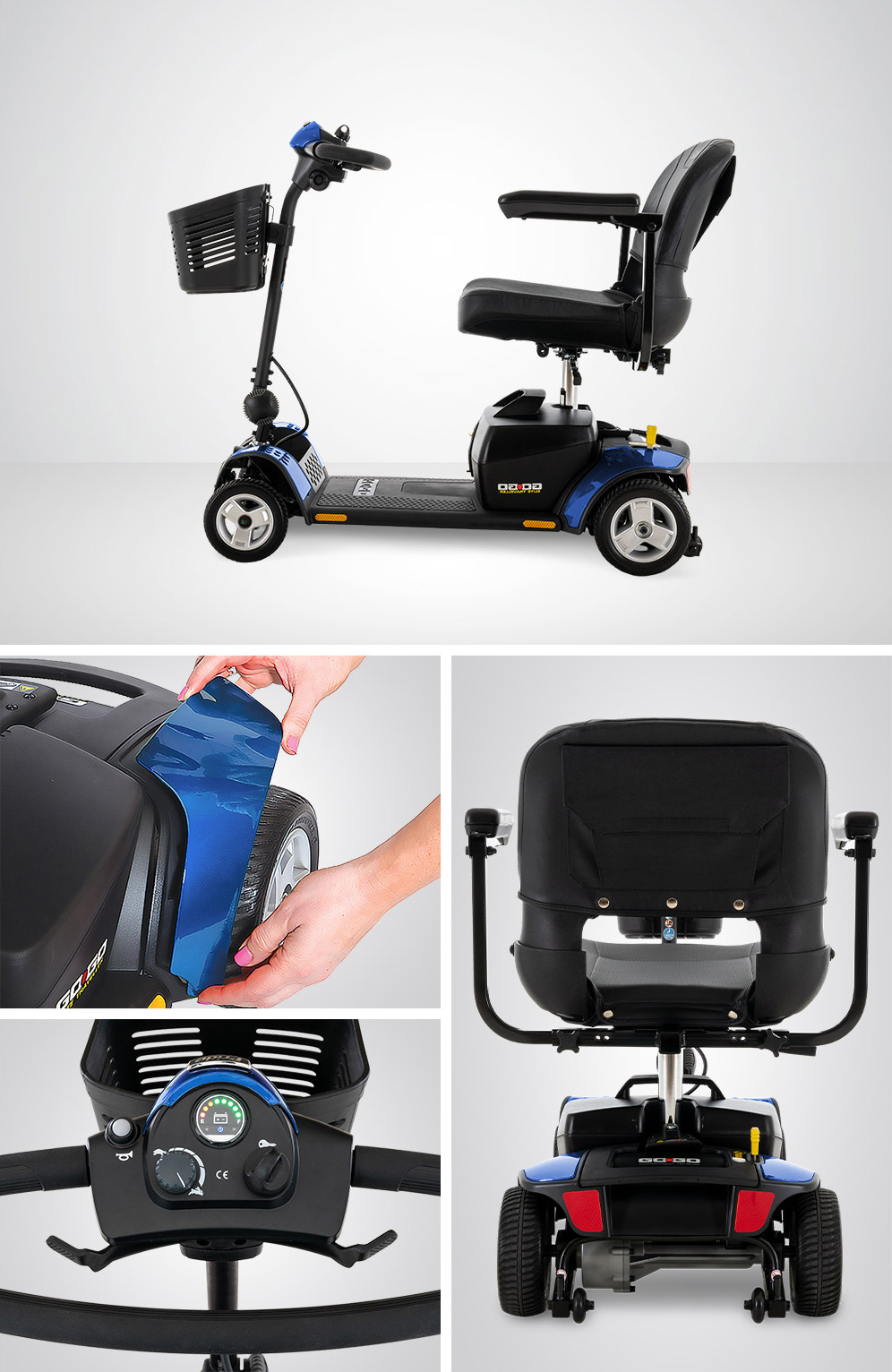
Pride Mobility is headquartered in Duryea, Pennsylvania, and manufactures products distributed in over 100 countries. Scale brings both advantages and challenges — their dealer network is extensive, parts are reliably available, and their warranty service is generally responsive. But at that scale, product quality across the full range varies more than it does for focused manufacturers.
The Pride Go-Go Elite Traveller has been a consistent top-seller for years because it does exactly what straightforward daily users need: starts reliably, steers intuitively, disassembles simply, and costs less than most premium alternatives. It's not the most exciting scooter in any category. It is, however, one of the most consistently satisfying ownership experiences — particularly for first-time buyers who don't want to manage complex systems.
Pride's Jazzy power wheelchair lineup is arguably more technically impressive than their scooter range, which is worth knowing if your eventual needs might include a power chair upgrade. Staying within one brand's ecosystem simplifies dealer relationships and parts sourcing.
Drive Medical and Emerging Brands — What the Broader Market Offers
Drive Medical has built its reputation on accessibility and distribution rather than premium engineering. Their ZooMe Auto-Flex is a genuinely capable automatic-folding travel scooter at a price point that makes the category accessible to buyers who can't justify the cost of an EV Rider AF Plus or ATTO Sport. For occasional-use situations — a family vacation, post-surgery recovery, periodic shopping assistance — Drive Medical delivers real value.
Among newer entrants, Enhance Mobility deserves attention specifically for their Transformer series. The Transformer 2 is an automatic-folding scooter with genuine engineering sophistication — a power-fold system that works smoothly even after extended use, an adjustable tiller, and a seat design that accommodates longer rides more comfortably than most travel models at similar price points.
Merits Health occupies an interesting position — their full lineup includes everything from lightweight travel scooters to rehabilitation-focused power chairs, with a consistency of engineering quality that often surprises buyers who encounter the brand for the first time. Their Silverado Extreme is one of the genuinely capable heavy-duty options in the market — 500 lb capacity, full suspension, a turning radius competitive with lighter models.
Brand Comparison Table — The Honest Version
Comparison tables can flatten nuance in unhelpful ways. This one tries to reflect actual ownership experience rather than just spec-sheet numbers. Ratings reflect real-world performance across the brand's overall lineup, not their single best model.
Comfort, Portability, Range, and Price — Side by Side
| Brand | Comfort | Portability | Battery Range | Warranty & Service | Price Range | Best For |
|---|---|---|---|---|---|---|
| Golden Technologies | Excellent | Good | 10–25 mi | Excellent | $900–$3,500 | All-round daily use, upgrade path |
| EV Rider | Good | Excellent | 8–18 mi | Good | $700–$2,800 | Travel & airline, folding priority |
| Shoprider | Excellent | Good | 12–25 mi | Good | $700–$2,400 | Value-focused, outdoor versatility |
| Pride Mobility | Good | Good | 10–18 mi | Excellent | $600–$2,200 | First-time buyers, simple daily use |
| Drive Medical | Moderate | Good | 8–15 mi | Good | $500–$1,800 | Budget-conscious, occasional use |
| Merits Health | Good | Moderate | 12–22 mi | Good | $800–$3,000 | Heavy-duty needs, rehab users |
| Enhance Mobility | Good | Excellent | 10–15 mi | Moderate | $900–$2,200 | Auto-fold travel, airline approved |
⚠️ Table note: Battery range figures reflect typical real-world use on flat surfaces at moderate speed. Carpet, inclines, heavier riders, and cold temperatures all reduce effective range. Manufacturer maximum range claims are measured under ideal conditions — expect 70–85% of that number in normal daily use.
How to Choose the Right Brand for Your Lifestyle — Not Just Your Diagnosis
Here's the thing about mobility scooter buying advice: it gets too diagnosis-focused too quickly. "I have arthritis, which brand is best?" overlooks that two people with identical diagnoses can have completely different daily routines, living situations, transportation access, and physical capabilities. The right question isn't about your condition — it's about your life.
According to the World Health Organization's research on ageing and health, maintaining mobility and social participation significantly impacts quality of life outcomes for older adults. A scooter that keeps you socially active — that you'll actually bring to places because it's manageable — matters more than one with superior specifications that stays in the garage.
Indoor Shopping, Daily Errands, and Community Use — Prioritize Maneuverability
If your primary environment is shopping centers, pharmacies, restaurants, and indoor community spaces — your decision framework should center on turning radius, portability, and long-session comfort. Speed and outdoor range become secondary concerns almost entirely.
For this profile:
- Golden Technologies Buzzaround series — particularly the LT and CarryOn for portability, the LX for indoor comfort
- EV Rider Transport AF Plus — if automatic folding and airline approval matter for travel days
- Shoprider Dasher 4 — if budget is a significant constraint and reliability is the priority
- Pride Go-Go Elite — if simplicity of operation is the overriding factor
Read through the full guide on choosing the right mobility scooter if you want a deeper breakdown of indoor-use considerations beyond brand comparison.
Outdoor Terrain, Long-Distance Riding, and Mixed Environments — Prioritize Stability and Range
If you spend significant time outdoors — uneven sidewalks, parks, neighborhood streets, shopping center parking lots — the calculus shifts. Suspension quality, wheel size, ground clearance, and battery capacity move to the top of the priority list. A tight turning radius matters less when you have space to work with.
For this profile:
- Golden Technologies Avenger or Companion HD — best combination of outdoor capability and service reliability
- Shoprider 6Runner 14 — particularly for users who need genuine rough-terrain performance without the Avenger's price point
- Merits Health Silverado Extreme — for high-capacity outdoor needs where 400–500 lb ratings are relevant
- EV Rider Vita Monster — if you want EV Rider's design language in a heavy-duty outdoor configuration
Mixed-environment users — people who split time fairly evenly between indoor retail spaces and outdoor community settings — often find that mid-size models like the Golden Companion Mid-Size or Shoprider Streamer Sport hit the right balance. Neither extreme, genuinely capable at both.
And honestly? For users who are genuinely uncertain — who move between environments regularly and can't predict which will dominate — the safest advice is to choose based on service access first. Pick the brand with the best local dealer support in your area, then choose the best model within that brand for your primary use case. That hierarchy serves people better long-term than optimizing purely on paper specifications.
Conclusion — There's No Universal Best Brand, But There Are Clear Right Choices
After comparing these brands across their lineups, the honest answer is that the best mobility scooter brand is the one that serves your specific combination of physical need, daily routine, transport situation, and service access. Golden Technologies wins on engineering consistency and upgrade path flexibility. EV Rider wins on portability and travel integration. Shoprider wins on value-per-dollar and outdoor range. Pride wins on simplicity and service network scale.
What they all share — the ones worth your money — is a genuine commitment to the user's independence rather than just the initial sale. That shows in warranty terms, parts availability, design iteration based on real feedback, and dealer training. Those invisible factors matter as much as any turning radius measurement or battery watt-hour rating.
The mobility scooter FAQ guide covers the practical questions that come after you've narrowed your brand choice — maintenance, battery care, insurance coverage, and more. Worth reading before finalizing any decision.
FAQs — Questions Buyers Actually Ask Before Choosing a Brand
Golden Technologies and Shoprider both have strong track records for daily-use reliability over multi-year ownership. Golden edges ahead on engineering consistency and parts availability; Shoprider edges ahead on value-for-money at similar reliability levels. For purely travel/folding use, EV Rider's Transport series has earned genuine reliability credibility through a large installed user base.
For daily-dependency users — people whose scooter is a genuine lifeline to independence — yes, the premium is typically justified. Golden's manufacturing quality, warranty service, and parts availability create a meaningfully better long-term ownership experience. For occasional use or post-surgery recovery situations, the price premium may not be necessary.
EV Rider's Transport series — particularly the Transport AF Plus and Transport 4AF — is the most consistently recommended for airline travel. Their batteries meet FAA guidelines, the folded dimensions fit most vehicle trunks and overhead baggage situations, and the automatic-fold mechanism reduces physical strain during transport. Enhance Mobility's Transformer 2 is a strong alternative, especially at a slightly lower price point.
Standard travel scooters typically accommodate up to 250–300 lbs. Mid-size models handle 300–350 lbs. Heavy-duty models — like the Golden Avenger, Shoprider 6Runner, and Merits Silverado Extreme — accommodate 400–500 lbs with structural engineering throughout the frame, not just a higher-rated seat. For users near or over 300 lbs, choosing a model rated 50–75 lbs above your body weight provides a meaningful reliability margin.
For daily-dependency users, local dealer access is critically important — arguably more important than any individual product specification. A scooter that can't be serviced for three weeks because parts are on back-order creates real hardship. Golden Technologies and Pride Mobility have the most extensive North American dealer networks. Verify local dealer availability for any brand before purchasing, not after.
Functionally, switching brands is fine — controls and operational conventions are similar enough across major brands that adaptation is rarely difficult. Practically, there's a real advantage to staying within Golden's ecosystem specifically, because their lineup spans from compact travel to heavy-duty outdoor without losing design-language continuity. That said, EV Rider for travel and Golden for full-size is a common and logical two-scooter combination for frequent travelers with variable daily needs.
Medicare Part B may cover a power-operated vehicle (mobility scooter) if a physician documents medical necessity for in-home use. Coverage isn't brand-specific — it depends on the device category and your documented functional limitations. Golden Technologies, Pride, and Drive Medical are all frequently covered through Medicare when prescribed appropriately. The documentation requirements are strict; working with a physician familiar with the process makes a significant difference.
Related reading
- Which mobility scooter is right for you?
- 7 tips to choose the best mobility scooter for your needs
- Mobility scooters vs. power wheelchairs — what's right for you?
- Types of mobility scooters explained
- Best selling mobility scooters of 2025
- NCOA — Facts on Healthy Aging and Mobility
- WHO — Ageing and Health
- CMS Medicare Coverage Database — Mobility Devices