





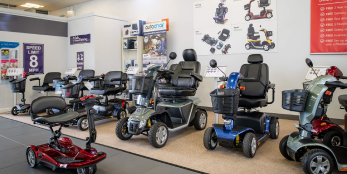


3-Wheel vs 4-Wheel Mobility Scooters: Which Is Safer for You?
Every week someone asks me whether three wheels are dangerous. The honest answer annoys people, because it isn't yes or no — it's "safer at what?" A 3 wheel scooter is measurably safer inside a crowded pharmacy. A 4 wheel scooter is measurably safer on a sloped driveway. Both statements are true at the same time.
4 wheel mobility scooters are more stable on uneven outdoor terrain, slopes, and at higher speeds. Their wider front wheelbase resists lateral tipping. 3 wheel scooters are safer indoors, where their tighter turning radius (typically 38–48 inches vs 50–65 inches) prevents the awkward multi-point turns and collisions that cause most real-world incidents.
Choose based on where you'll spend 80% of your riding time — not on which sounds sturdier.
The Short Answer on Safety — and Why Most Buyers Get It Backwards
Here's the thing that surprised me most in nearly two decades of fittings. Most people arrive convinced that four wheels equals safe and three wheels equals risky. It's intuitive. It's also, in the environments where most of my clients actually ride, backwards.
Think about where injuries genuinely happen. Not on gravel paths at speed — that's rare. They happen in doorways. In grocery aisles. Reversing out of a tight spot at the pharmacy counter while three people wait behind you. A wide, long 4 wheeled scooter in that scenario forces six-point turns, clips displays, catches door frames. Every one of those moments is a chance to be hurt or to hurt somebody else.
And yet a three wheeled electric scooter on a cambered sidewalk with a 3-inch drop at the driveway apron? That's the situation where the single front wheel gives you less margin. That's real too.
So the safety question isn't about wheel count in isolation. It's about matching the machine to the terrain you actually live on.
Are 3 Wheel Mobility Scooters Safe? The Tipping Question, Answered Honestly
Let me tell you about the only tip-over I've personally witnessed. Client in his late sixties, sharp as anything, riding a three wheeled scooter he'd owned for two years without incident. He turned into his own driveway — at the apron, where the sidewalk drops — at close to full speed while turning. The front wheel loaded up, the inside rear lifted, and over he went. Scraped elbow. Bruised pride. Nothing broken.
Here's what matters about that story: it wasn't the third wheel that did it. It was speed plus turn plus slope, all at once. A four wheel scooter would probably have stayed upright. But he'd also made the same turn hundreds of times before without trouble — the difference that day was he was hurrying.
The physics are straightforward. A 3 wheel scooter has a triangular support base. When you turn, centrifugal force pushes weight toward the outside. Combine a sharp turn with a cross-slope and enough speed, and the load can exceed the triangle's edge. Four wheels create a rectangular base, so that edge is farther away in every direction.
⚠️ The rule I give every client with a 3 wheel scooter: slow to walking pace before you begin the turn, not during it. Almost every 3-wheel incident I've reviewed involved braking and turning simultaneously. Separate those two actions and the stability difference between three and four wheels shrinks dramatically.
Are three wheel scooters safe? For indoor and level-surface use — yes, genuinely, and often safer than the alternative. For riders who spend real time on cambered sidewalks, grass, gravel, or hills — four wheels give you meaningful margin you'll be glad to have. The U.S. Consumer Product Safety Commission tracks mobility device incidents, and the pattern across reported cases mirrors what I see clinically: environment and speed drive outcomes far more than wheel count alone.
Who should lean 4-wheel for safety reasons specifically
- Riders with balance disorders, vertigo, or vestibular conditions — the perceptual reassurance matters as much as the physics
- Anyone over roughly 280 lbs, where center of gravity sits higher
- Riders with limited trunk control who shift position while moving
- People living on hilly terrain or with steep driveways
- Riders who've had a previous fall and carry understandable anxiety about it
Mobility Scooter Turning Radius: The Number That Actually Decides This
If you take one thing from this article, take this. Turning radius is the most under-discussed and most consequential spec in the entire scooter category — and almost no product listing puts it above the fold.
Turning radius is the tightest circle the scooter can complete. Under 44 inches, you can rotate inside most retail aisles. Between 45 and 52, you'll manage but you'll plan ahead. Above 55, you're doing three-point turns in clothing stores and reversing out of restaurant seating areas.
Here's how the popular models actually measure up:
| Model | Wheels | Turning Radius | Weight Capacity | Indoor Rating |
|---|---|---|---|---|
| EV Rider MiniRider | 3 | ~38 in | 250 lbs | Excellent |
| Buzzaround LX 3-Wheel | 3 | ~42 in | 300 lbs | Excellent |
| Buzzaround EX 3-Wheel | 3 | ~43 in | 300 lbs | Excellent |
| Golden LiteRider 3-Wheel | 3 | ~44 in | 300 lbs | Excellent |
| Buzzaround XLS-HD 3-Wheel | 3 | ~46 in | 325 lbs | Very good |
| Shoprider Streamer Sport | 3 | ~47 in | 350 lbs | Very good |
| Golden Companion 3-Wheel | 3 | ~48 in | 400 lbs | Very good |
| Buzzaround LX 4-Wheel | 4 | ~50 in | 300 lbs | Good |
| Buzzaround EX 4-Wheel | 4 | ~52 in | 300 lbs | Good |
| Shoprider Dasher 4 | 4 | ~53 in | 300 lbs | Good |
| Merits Pioneer 4 | 4 | ~55 in | 350 lbs | Moderate |
| Golden Companion 4-Wheel | 4 | ~58 in | 400 lbs | Moderate |
| Golden Avenger | 4 | ~58 in | 500 lbs | Moderate |
Figures are approximate and vary by seat position and tire configuration. Always confirm against current manufacturer specs before purchase.
Notice the pattern. The 3-wheel configurations cluster between 38 and 48 inches. The 4-wheel versions of the same scooters land between 50 and 58. That 10-inch difference sounds trivial written down. Standing in a doorway, it's the difference between gliding through and getting stuck.
📏 Do this before you buy: measure the narrowest doorway in your home and the tightest aisle at the store you visit most. Write both numbers down. Then compare them against the turning radius column above. It takes ten minutes and it prevents the single most common regret I hear.
3 Wheel Scooters for Adults: Where They Genuinely Win
A three-wheeled mobility scooter earns its place through maneuverability and front legroom — two things people underestimate until they've lived with the alternative.
The front legroom point deserves more attention than it gets. With one front wheel instead of two, the floorboard opens up. Riders with knee replacements, hip stiffness, or leg length differences often find a 3 wheel electric scooter simply more comfortable to sit in for two hours. That's not a minor consideration when the scooter is your primary way of getting around.
Best environments for a 3 wheel disability scooter
- Shopping malls and grocery stores — where aisle width is the constraint
- Apartments and smaller homes — interior doorways run 30–32 inches
- Restaurants, medical offices, places of worship — tight seating layouts
- Cruise ships — corridors and cabin doorways are notoriously narrow
- Anywhere you reverse frequently — checkout lanes, elevators
Standout 3 wheel scooters for adults

The Buzzaround EX 3-Wheel is the model I recommend most often for indoor-primary riders. It disassembles into manageable pieces, the tiller controls need almost no grip strength (which matters enormously for arthritis), and the turning radius lets you use it in stores that defeat larger scooters.
For riders wanting something lighter still, the EV Rider MiniRider has the tightest turning radius of anything in the standard range — around 38 inches. It's a genuinely compact three wheel scooter for seniors who mostly ride indoors and need something that loads into a car without a lift.
If you need more capacity without abandoning the 3-wheel advantage, the Golden Companion Full Size 3-Wheel handles 400 lbs while keeping the turning radius under 50 inches. That combination is harder to find than you'd expect.
4 Wheel Scooters: Where They Genuinely Win
Now the other side. A 4 wheeled scooter buys you stability, and stability buys you confidence — which turns out to matter as much psychologically as it does physically.
I've watched clients who were nervous on three wheels become noticeably more relaxed on four. They ride further. They go out more. Whether or not the four wheel version was objectively safer for their environment, it was safer for them, because they used it more and pushed themselves less anxiously. That's a real clinical outcome, and I've stopped dismissing it.
Best environments for a four wheel scooter
- Outdoor sidewalks with camber — most sidewalks slope toward the street
- Grass, gravel, packed dirt — parks, campgrounds, fairgrounds
- Sloped driveways and ramps — where lateral tipping risk peaks
- Longer distances at higher speed — stability scales with speed
- Heavier riders — higher center of gravity needs a wider base

The Golden Companion 4-Wheel is the four wheel scooter for adults I point to most. Full suspension, 400 lb capacity, and enough ground clearance to handle a lawn without drama. It's not a store scooter — the turning radius tells you that — but for outdoor-primary riders it's excellent.
The Merits Pioneer 4 sits at a more accessible price point with 350 lb capacity, and the Shoprider Dasher 4 is a legitimately good value 4 wheel drive scooter for mixed use.
Same Scooter, Both Configurations — The Cleanest Comparison You'll Find
This is where the decision gets genuinely easy. Several manufacturers build the identical scooter in both configurations, so you can isolate the wheel variable without also changing brand, price, or feature set.
Better legroom, easier in stores and doorways. My default pick for riders who shop indoors more than they ride outdoors.

Same motor and battery, wider front stance. Choose this if your route includes sloped sidewalks or grass.

Longer range than the EX with the same indoor agility. Good for riders covering more ground daily.

The extended-range option with four-wheel stability. Popular with riders who use it for neighborhood travel.

The most comfortable seat in the Buzzaround family. Best 3 wheel mobility scooter for long sessions.

Comfort plus stability. The tightest turning radius of any 4-wheel in this comparison — a genuine sweet spot.

Heavy-duty build without the width penalty. Rare combination worth knowing about.

Higher capacity than the 3-wheel version. If you're over 325 lbs, this is the configuration you need.

The entry point. Light enough to disassemble and load without help — a real factor for solo riders.

Same portability, more planted feel. Good compromise for nervous first-time riders on a budget.

Automatic folding plus the tightest radius in the folding category. The travel option.

Folding convenience with four-wheel confidence. Excellent for travelers who also ride outdoors.
Still Not Sure Which Configuration Fits Your Life?
Tell us where you ride, what you weigh, and how you transport it — we'll match you to the right scooter and stand behind it.
- Lowest Price Guarantee
- Free Batteries & Charger
- Full Factory Warranty
- Financing Available
Which Should You Actually Buy? A Straight Decision Framework
Skip the pros-and-cons paralysis. Answer these four questions honestly and the answer usually declares itself.
| Question | If yes → 3-Wheel | If yes → 4-Wheel |
|---|---|---|
| Where do you ride 80% of the time? | Indoors — stores, home, offices | Outdoors — sidewalks, parks, yards |
| Is your home or route hilly? | No, mostly level | Yes, slopes or cambered walks |
| Do you weigh over 280 lbs? | No | Yes |
| Any balance disorder or prior fall? | No | Yes |
| Do you need extra front legroom? | Yes | Not a concern |
| Narrow doorways at home (under 32 in)? | Yes | No, wide access |
✅ Genuinely mixed use? Go 4-wheel, but pick one with an unusually tight turning radius — the Buzzaround LX 4-Wheel at roughly 50 inches is the best compromise I've found. You give up a little indoor agility and gain real outdoor security.
Where I'll admit uncertainty: riders in the 250–280 lb range with no balance issues but genuinely mixed terrain. I've recommended both configurations to people in that band and been second-guessed by the outcome roughly as often as I've been right. There isn't a clean rule there. Test-ride if you possibly can.
Heavy-Duty and 500 lb Capacity Options — Where 4 Wheels Stop Being Optional
Above roughly 350 lbs, the conversation changes. Heavy duty mobility scooters at 500 lbs capacity are essentially all four-wheel designs, and that's engineering, not preference. The frame stresses and center-of-gravity math don't leave room for a three-wheel option at that rating.

The Golden Avenger is the standout: 500 lbs, full suspension, dual batteries, and a turning radius around 58 inches that's genuinely usable indoors. The Merits Silverado Extreme and EV Rider Vita Monster occupy similar territory with slightly different range and comfort trade-offs.
The 3-wheel exception worth knowing about
There's one category that quietly breaks the "3 wheels are less stable" rule — all-terrain recreational three wheelers. These use a wide front fork, long wheelbase, and low center of gravity to achieve stability that rivals four-wheel designs. The Bespoke Regal 3-Wheel and Bespoke Legacy 3-Wheel are genuinely different animals from a standard 3 wheel scooter — heavier, longer, and far more planted on rough ground.
If you've dismissed three wheels purely on stability grounds, look at these before you finalize. They're the counterexample that complicates the tidy rule.
Mobility Scooter Safety Tips That Actually Reduce Incidents
Whichever configuration you choose, these matter more than wheel count. I give this list to every client at handover.
- Slow before the turn, not during it. The single highest-value habit, especially on three wheels.
- Approach curb cuts and driveway aprons straight on — never at an angle. Angled approaches on slopes cause more incidents than any other single maneuver.
- Reverse slowly and check behind first. Most scooter-pedestrian collisions happen in reverse.
- Keep the basket load low and centered. A heavy bag hung on one side of the tiller measurably shifts your center of gravity.
- Check tire pressure monthly on pneumatic tires. Underinflation degrades cornering stability noticeably.
- Use the speed dial as a limiter, not a suggestion. Set it low indoors. Genuinely.
- Don't ride in the road where a sidewalk exists. The ADA's guidance on mobility devices covers your right of access in public spaces — worth knowing.
One digression I keep starting and never finishing: I think our sidewalk infrastructure is quietly hostile to wheeled mobility in ways nobody designed on purpose. The camber that sheds rainwater is the same camber that destabilizes a scooter. Curb cuts built to code are often still too steep at the transition. Research from the CDC on disability and health keeps connecting mobility to health outcomes — and the built environment is doing more of that work than we acknowledge. Anyway. Not something I can fix in a buying guide.
Ready to Choose With Confidence?
Browse both configurations side by side, with real specs, real support, and a team that answers the phone.
- Expert fitting guidance
- In-home service available
- Factory-authorized dealer
Frequently Asked Questions
Yes, for indoor and level-surface use — and often safer than 4-wheel models in those environments, because the tighter turning radius prevents the collisions and awkward maneuvers that cause most real incidents. Three wheel scooters become riskier on cambered sidewalks, slopes, and at higher speeds. The key safety habit is slowing to walking pace before turning rather than braking mid-turn.
Typically 10–12 inches. Three wheel scooters generally turn in 38–48 inches; four wheel versions of the same model need 50–58 inches. Standard interior doorways are 30–32 inches wide and retail aisles vary widely, so that difference determines whether you glide through or perform a three-point turn. Always measure your narrowest doorway before buying.
Most standard mobility scooters top out between 4 and 5 mph — roughly a brisk walking pace. Heavy-duty and recreational models can reach 8–15 mph. Higher speeds meaningfully increase tipping risk on three wheel scooters during turns, which is one reason faster models are almost always four-wheel designs.
Lightweight folding travel scooters run 50–70 lbs. Standard 3 wheel and 4 wheel scooters typically weigh 90–150 lbs assembled, though many disassemble into 25–40 lb pieces. Heavy-duty models can exceed 250 lbs and usually require a vehicle lift. Three wheel versions are generally 8–15 lbs lighter than their four wheel counterparts.
Answer four questions: Where do you ride most (indoors or outdoors)? Is your route hilly or level? Do you weigh over 280 lbs? Do you have any balance condition or prior fall history? Indoor, level, under 280 lbs, no balance issues points strongly to 3-wheel. Any two "outdoor/hilly/heavier/balance concern" answers points to 4-wheel. For genuinely mixed use, choose a 4-wheel with an unusually tight turning radius.
The EV Rider Transport AF+ is the most-recommended folding 3-wheel option — automatic folding, roughly a 40-inch turning radius, and airline-approved battery specs. If you want folding convenience with four-wheel stability, the EV Rider Transport 4AF is the direct counterpart. Both fold into most vehicle trunks without a lift.
Entry-level 3 wheel and 4 wheel scooters typically start around $900–$1,400. Mid-range models with better suspension and range run $1,500–$2,500. Heavy-duty 500 lb capacity scooters and all-terrain recreational models range from $2,500 to $6,000+. Four wheel versions of the same model usually cost $100–$300 more than the three wheel configuration. Financing options are available on most models.
Yes — genuine two-seater scooters exist, and they're all four-wheel designs for stability reasons. The Afikim Afiscooter S3 and S4 dual-seat models are the main factory-built options. They're heavy (250–400 lbs) and require a vehicle lift or trailer for transport, so plan logistics before purchasing.
Yes, but with more planning. Four wheel scooters need 50–58 inches to turn, which works in wider supermarket aisles and open spaces but becomes difficult in clothing stores, small pharmacies, and restaurants. If indoor use is significant, look for a 4-wheel with a turning radius at the low end of the range — around 50 inches — rather than a full-size outdoor model.
A last, slightly unresolved thought: I've fitted hundreds of these and I still can't give you a rule that works every time. The person who rides cautiously on three wheels is safer than the person who rides fast on four. The scooter that fits through your front door gets used; the one that doesn't sits in the garage being theoretically more stable. Wheel count is a real factor, but it's not the biggest one — you are. Which is either reassuring or unsettling, depending on the day.
Related reading
- Which is better: a 3 wheel or 4 wheel scooter?
- How safe are 3 wheel mobility scooters?
- Are 3 wheel scooters any good?
- Which mobility scooter is right for you?
- Types of mobility scooters explained
- Mobility scooters for heavy adults
- Top 5 safest mobility scooters
- ADA — Mobility Devices in Public Spaces
- CDC — Disability and Health
- NCOA — Facts on Healthy Aging