



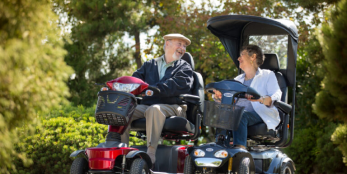

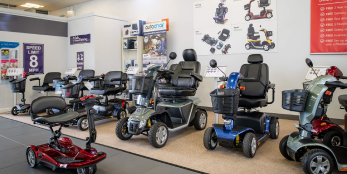


Two people. One scooter. It sounds simple until you actually try to make it work — and then you discover that most "2-seater" scooters are really one-and-a-half-seaters with a marketing budget. This is the honest guide to the ones that genuinely carry two adults, and the situations where you'd be better off with something else entirely.
I've spent 15 years fitting mobility equipment, and the tandem-scooter question comes up more than you'd expect. A husband and wife who both tire easily but want to shop together. An adult daughter caring for her mother who needs to ride alongside her through a botanical garden. A couple on a cruise who refuse to travel in separate vehicles across the terminal. These are real people with a real need — and the market has quietly built some genuinely good answers, alongside a lot of overpromising junk.
Let me walk you through what actually works.
Who Actually Needs a 2-Seater Mobility Scooter?
Here's the thing most product pages won't tell you: a lot of people who think they need a 2-seater actually don't. So before we get into models, let's figure out whether you're genuinely in this category — because these scooters cost more, weigh more, and transport harder than single-seat models.
You're a real candidate for a tandem scooter if:
- Both riders have mobility limitations. Two people who both fatigue quickly, both have arthritis, or both struggle with distance — that's the classic couples case.
- One is a caregiver who needs to stay physically beside the other. Not behind, not walking alongside — beside, at the same pace, able to assist instantly.
- You travel together constantly — cruises, malls, large parks, airports — and separating into two devices creates logistical headaches every single time.
- A young child or grandchild rides along. Some couples want a second seat specifically for a small passenger during outings.
The World Health Organization's research on ageing and health keeps circling back to one point: social participation and shared activity are protective for older adults. A scooter that lets a couple stay together — physically, in the same space, doing the same thing — isn't just convenient. For some people it's the difference between going out and staying home. That matters more than any spec sheet.
💬 A pattern I've noticed: The couples happiest with tandem scooters are the ones who were about to stop going out together entirely. When one partner's mobility declines faster than the other's, the shared outing quietly disappears. A 2-seater brings it back. That emotional payoff is real — and it's why I don't dismiss this category even though the engineering trade-offs are significant.
How 2-Seater Scooters Actually Work (And Where They Hit Their Limits)
A true 2-seater carries two adults. That's a heavier engineering problem than it sounds. You're now asking a motor to move potentially 400–600 lbs of combined rider weight, plus the scooter's own frame, plus whatever shopping bags come along. That has consequences.
There are really three configurations you'll encounter:
Side-by-Side Bench Seating
Two people sitting next to each other on a wide bench. This is what most couples picture, and it's the most social arrangement — you can talk, hold hands, share the view. The downside is width. A side-by-side scooter is wide, which makes indoor use in tight retail spaces genuinely difficult. Doorways become a calculation. These work beautifully outdoors and in open spaces, less so inside a crowded department store.
Tandem (Front-and-Back) Seating
One rider in front operating the tiller, one behind. Narrower than side-by-side, so it handles better indoors. The catch is that the rear passenger is purely a passenger — no controls, less legroom, and a view of the back of someone's head. It works, but it's less companionable. Good for a caregiver driving with a patient behind, less ideal for two equal partners who want to share the experience.
Convertible & Removable Second Seats
Some models add or remove the second seat depending on need. This flexibility is genuinely useful — solo errands during the week, tandem outings on weekends. The trade-off is usually a compromise in both modes: the second seat isn't as comfortable as a dedicated design, and the solo mode carries extra frame weight it doesn't need.
⚠️ The limit nobody advertises: Combined weight capacity is the number that actually governs everything. A scooter rated for 500 lbs total means two 200-lb adults leave only 100 lbs of margin — and that margin shrinks your range, your hill-climbing ability, and your battery life noticeably. Always add both riders' real weights (not aspirational weights) and leave a genuine buffer. This is where most disappointed buyers went wrong.
What to Look For — Beyond the Marketing Copy
When I'm helping a couple choose, I ignore the glossy language and go straight to five numbers. These tell you almost everything.
1. Combined Weight Capacity (The One That Rules Them All)
Add both riders. Add a realistic buffer of at least 75–100 lbs for bags, buffer, and long-term battery health. If the combined real weight is 400 lbs, you want a scooter rated for 500+. Don't shop at the edge of the rating — scooters run near their maximum capacity feel sluggish and wear faster.
2. Motor Power and Realistic Range
Two riders drain a battery faster than one. Manufacturer range figures are measured with a single average-weight rider on flat ground. With two people and any inclines, expect 60–70% of the advertised range in real use. For genuine all-day outings, look for scooters with larger battery banks — and ideally lithium systems, which hold voltage more consistently as they drain. The FAA's battery guidance for passengers is worth reading if you'll ever fly with the scooter.
3. Width and Turning Radius
This is the indoor make-or-break. Side-by-side models can exceed 30 inches in width — too wide for many store aisles and some home doorways (standard interior doors are often 30–32 inches). Measure your doorways. Measure the aisles at the places you actually shop. A tandem scooter that can't get through the front door of your favorite store is an expensive outdoor-only device.
4. Stability and Wheel Configuration
With two riders and a higher center of gravity, stability matters more than on single-seat models. Four-wheel configurations are almost always the right call for 2-seaters. The wider wheelbase and four contact points handle the shifting weight of two passengers — especially on turns and slopes — far better than three wheels. For 2-seaters specifically, I rarely recommend a 3-wheel design.
5. Comfort for Both Riders
Test both seats. Genuinely. The driver's seat on most models is well-designed; the passenger seat is sometimes an afterthought. Check the second seat's cushioning, backrest support, and — critically — whether the passenger has somewhere comfortable to put their feet and hands. A two-hour outing reveals problems that a showroom sit-test hides.
Best 2-Seater & Tandem-Capable Scooters for 2026
Now the honest part. Genuine factory-built 2-seaters are a small category — most of the market is single-seat. But there are strong options for couples and caregivers, ranging from true tandems to heavy-duty single scooters robust enough that a companion attachment or higher capacity makes shared use realistic.
Afikim Afiscooter S — The Genuine Dual-Seat Standard

If you want an actual, factory-engineered two-seater, the Afikim Afiscooter S3 Dual Seat is the one I point people to first. This is a heavy-duty, all-terrain scooter built from the ground up to carry two adults — not a single-seater with a bolted-on afterthought. The dual bench is wide, genuinely comfortable, and the suspension is engineered for the combined load.
The Afiscooter S4 Dual Seat takes it further with a four-wheel platform, higher ground clearance, and the stability you want when two people are aboard on uneven outdoor terrain. These aren't cheap, and they're not compact — but for couples who spend real time outdoors together, parks, boardwalks, large properties, they're the closest thing to a purpose-built answer. Add the optional canopy and you've got weather protection for both riders too.
✅ My take: The Afiscooter dual-seat models are the only scooters in this guide I'd call true, no-compromise 2-seaters. If a genuine tandem is non-negotiable and outdoor use dominates, start here. Just be realistic about size — these need a proper vehicle lift or trailer for transport.
Heavy-Duty Singles That Handle Shared Use

For couples where only occasional shared use is needed — a small child riding along, or a lighter second passenger — a robust heavy-duty single with high capacity often makes more practical sense than a full tandem. The EV Rider Vita Monster and Merits Health Silverado Extreme both offer 400–500 lb capacities and the frame strength to handle more than a single average rider. They won't seat two adults comfortably side by side — but for a parent-and-child pairing or brief shared rides, they're far easier to live with day-to-day.
Browse the full heavy-duty mobility scooter collection if capacity is your priority — several models there carry the structural rating that shared use demands.
Recreational Scooters for Active Couples
Couples who want tandem capability specifically for leisure — trails, campgrounds, waterfront paths — should look at the recreational scooter category. Models like the Afikim Afiscooter SE are built for longer-distance outdoor enjoyment, and the Afikim recreational line includes dual-seat configurations designed for exactly this kind of shared adventure. These prioritize range, comfort, and terrain capability over indoor maneuverability — which is the right trade for outdoor-focused couples.
Not Sure Which 2-Seater Fits Your Situation?
Every couple and caregiver pairing is different. Suncoast Mobility's team can help you match combined weight, transport needs, and terrain to the right scooter — and back it up with real support.
- Lowest Price Guarantee
- Free Batteries & Charger
- Full Factory Warranty
- Financing Available
Side-by-Side Comparison — 2-Seater and Shared-Use Options
This table reflects real-world suitability, not just spec-sheet numbers. "Shared use" means two adults side by side; "occasional shared" means a lighter second rider or child.
| Model | Type | Combined Capacity | Best Environment | Transport | True 2-Seater? |
|---|---|---|---|---|---|
| Afiscooter S3 Dual Seat | Side-by-side bench | 500+ lbs | Outdoor, open spaces | Lift/trailer | Yes |
| Afiscooter S4 Dual Seat | Side-by-side, 4-wheel | 500+ lbs | Outdoor, uneven terrain | Lift/trailer | Yes |
| Afiscooter SE (Recreational) | Recreational, dual option | 450+ lbs | Trails, campgrounds | Lift/trailer | Config-dependent |
| EV Rider Vita Monster | Heavy-duty single | 400 lbs | Mixed indoor/outdoor | Vehicle lift | Occasional shared |
| Merits Silverado Extreme | Heavy-duty single | 500 lbs | Outdoor, long range | Lift/trailer | Occasional shared |
When a 2-Seater Isn't Actually the Right Answer
I'll be honest in a way that might cost a sale: for a lot of couples, two separate scooters beat one tandem. There, I said it.
Think about it. Two single scooters means each person controls their own device, each can go where they want, neither is a passenger. They're easier to transport (two lighter units often load more easily than one enormous tandem). They're cheaper to maintain individually. And if one breaks down, you're not both stranded.
The tandem makes sense when togetherness in the same device is the actual goal — a caregiver who must stay physically beside a patient, or a couple where one genuinely can't operate a scooter at all. But if both partners can drive independently, two folding travel scooters often deliver more freedom, not less. That's the honest recommendation I give maybe a third of the couples who come in asking for a 2-seater.
🤔 Where I genuinely go back and forth: The convertible single-seat-plus-removable-second-seat models. In theory they're the perfect middle ground. In practice, I've seen the second seat go unused after a few months because setup friction is real. But I've also seen couples love the flexibility. I honestly can't give you a clean rule on those — it depends on the specific pair, and I've been wrong predicting which way it'll go.
Transport, Storage & the Logistics Nobody Plans For

This is where tandem-scooter dreams meet driveway reality. A true 2-seater is heavy — often 250–400 lbs — and large. You are not folding this into a trunk. Plan the transport before you buy, not after.
Your realistic options:
- Vehicle lift. An electric vehicle lift mounted on a hitch receiver is the standard solution for heavy scooters. Check your vehicle's towing/hitch capacity against the scooter weight plus the lift.
- Trailer. For the largest dual-seat models, a small utility trailer is sometimes the only practical answer. Less convenient, but reliable.
- Wheelchair-accessible van. If you already have one, a ramp-and-tie-down setup handles most tandems without a separate lift.
Storage matters too. These scooters need real space — a garage bay, a shed, a covered area. They don't tuck into a closet. And if you live somewhere with winters, a heavy-duty scooter cover protects the investment through the off-season.
Charging is the last piece. Two-seaters with larger battery banks take longer to charge fully — often 8–10 hours from empty. If you're doing back-to-back outing days, factor that in.
Buying With Confidence — Why Where You Shop Actually Matters
A 2-seater is a significant purchase — often several thousand dollars. That's exactly the kind of buy where the retailer behind it matters as much as the scooter itself. I've watched people save a few hundred dollars buying from a faceless marketplace, then spend months trying to get warranty service on a scooter nobody will stand behind.
This is where Suncoast Mobility genuinely differentiates itself for higher-ticket mobility purchases:
- Lowest Price Guarantee — you're not sacrificing price for service.
- Free batteries and charger with every scooter — no surprise add-on costs on a purchase this size.
- Full factory warranty on every unit — the coverage that actually matters when something needs service.
- Financing options — because a few thousand dollars is easier to manage over time.
- In-home service contracts — for heavy scooters you can't easily transport back for repair, this is huge.
That last one deserves emphasis for tandem buyers specifically. When your scooter weighs 350 lbs, "bring it in for service" is a genuine hardship. In-home service turns a logistical nightmare into a scheduled visit. For a heavy 2-seater, that's not a nice-to-have — it's close to essential.
Ready to Keep Moving — Together?
Explore genuine dual-seat scooters and heavy-duty options built for couples and caregivers. Real support, real warranty, real people who understand what shared mobility means.
- Expert fitting guidance
- In-home service available
- Factory-authorized dealer
Frequently Asked Questions
Genuine factory-built two-seaters do exist — the Afikim Afiscooter dual-seat models are the clearest example, with wide bench seating engineered for two adults. But you should be skeptical of cheaper "2-seater" listings that are really single scooters with a small add-on seat. Always check the combined weight capacity and whether the second seat is a real, supported design or an afterthought.
Add both riders' real weights, then add a buffer of at least 75–100 lbs for bags and long-term performance. If your combined weight is 400 lbs, look for a scooter rated 500+ lbs. Running a scooter near its maximum rating reduces range, hill-climbing ability, and battery lifespan — so genuine headroom matters more than people expect.
Side-by-side dual-seat scooters are wide — often over 30 inches — which makes tight retail aisles and some doorways difficult. They shine outdoors and in open spaces. If indoor shopping is your main use, measure your doorways and store aisles carefully first, or consider whether two narrower single scooters might serve you better inside.
Often, yes — if both partners can operate a scooter independently. Two singles give each person control and freedom, transport more easily, and aren't both out of commission if one breaks. A tandem makes the most sense when a caregiver must stay physically beside a patient, or when one partner genuinely can't drive their own device. It comes down to whether shared-device togetherness is the actual goal.
True two-seaters weigh 250–400 lbs and won't fold into a trunk. Your realistic options are a hitch-mounted electric vehicle lift (check your vehicle's hitch capacity), a small utility trailer for the largest models, or a wheelchair-accessible van with a ramp. Plan transport before purchasing — it's the logistical detail that catches the most buyers off guard.
Yes — this is one of the strongest use cases. A tandem configuration lets a caregiver stay physically beside or in front of the person they're assisting, at the same pace, ready to help instantly. Front-and-back tandem seating works well here because the caregiver drives while the patient rides safely. For caregiver-patient pairs, the shared device is often genuinely superior to two separate scooters.
Yes. Suncoast Mobility includes a full factory warranty, free batteries and charger, and a lowest price guarantee on scooters — plus in-home service contracts, which are especially valuable for heavy two-seaters you can't easily transport for repair. Financing is also available. For a purchase this size, that combination of price protection and real service support matters as much as the scooter itself.
One last honest thought: The best 2-seater is the one that gets two people out the door together who'd otherwise stay home. That's the whole point — not the specs, not the range, not the turning radius. If a genuine tandem does that for you, it's worth every complication of size and transport. And if two separate scooters do it better? That's the right answer too, even though it's not the one you came here searching for. I'm still not sure there's a universal rule. There's just your specific two people, and the life you want to keep living together.
Related reading from Suncoast Mobility
- Top 5 two-seater mobility scooters for comfort and range
- Is there a mobility scooter for 2 people?
- 2-passenger recreational scooters explained
- Which mobility scooter is right for you?
- Recreational scooter collection
- WHO — Ageing and Health
- NCOA — Facts on Healthy Aging
- ADA — Mobility Devices in Public Spaces