





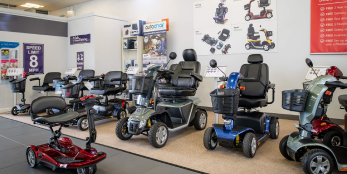


The first time a client of mine test-rode a 15 mph scooter, he came back grinning like a teenager and said, "I forgot moving could feel like this." That's the pull of fast scooters — and it's real. So is the physics of a 350-pound machine at triple walking speed. This guide covers both honestly.
Most standard mobility scooters top out at 4–5 mph — roughly a brisk walking pace. The fastest mobility scooters in 2026 reach 15 mph, led by recreational all-terrain models like the Bespoke Regal, Supreme, and Platinum (600W motors, up to 35-mile range). Between those extremes sit heavy-duty models at 9–14 mph.
There is no uniform national speed limit for mobility scooters in the US — but indoors and in pedestrian areas, facilities can legally require walking pace under ADA rules.
How Fast Can a Mobility Scooter Go? The Real Numbers
Let's start with the number nobody advertises: the average mobility scooter is slow. Deliberately. A standard 3- or 4-wheel scooter — the kind built for grocery stores and neighborhood sidewalks — cruises at 4 to 5 mph. That's not a limitation of the technology. It's a design choice, because those machines live among pedestrians, doorframes, and checkout lines, and walking pace is what that environment can absorb.
Recreational scooters are a different species. Bigger motors (600W and up versus 250–350W), bigger batteries, real suspension, and frames engineered for momentum. That's where the 12, 13, and 15 mph numbers live — and where the question changes from "how fast can it go" to "how fast should you go, and where."
Fifteen miles per hour, for context, is a quick recreational cyclist. It'll carry you three and a half miles in fifteen minutes. It will also cover 22 feet per second — which is why everything in the fast class comes with lighting systems, mirrors, real brakes, and speed selectors. The good manufacturers understand what they've built.
The Four Speed Classes, Compared
| Class | Top Speed | Typical Motor | Best Environment | Example Models |
|---|---|---|---|---|
| Standard | 4–5 mph | 250–350W | Indoors, stores, sidewalks | Buzzaround EX, Companion 4 |
| Heavy-duty comfort | 9.3 mph | ~950W | Outdoor daily use, large properties | Afiscooter S3, S4 Dual Seat |
| Performance heavy-duty | 11–14 mph | ~1100W | Hills, trails, long distance | Golden Eagle GR-Hawk class |
| Recreational flagship | 15 mph | 600W high-efficiency | Open paths, neighborhoods, trails | Bespoke Regal, Supreme, Platinum |
The Fastest Mobility Scooters for 2026 — The 15 MPH Class
The top of the speed range in 2026 belongs to the Bespoke all-terrain family: 600-watt motors, 15 mph top speed, up to 35 miles of range, and — this matters — three-speed selectors that let you dial the whole machine down to a civilized pace when the environment demands it. Fast when you want it. Slow when you should be.
Bespoke Regal — the one I'd pick
The Bespoke Regal 3-Wheel hits the full 15 mph and 35-mile range with spring suspension on every wheel, a full LED lighting package (headlight, taillight, brake lights, turn signals — genuine road-going visibility), remote key fob with alarm, and locking storage. It arrives fully assembled. Italian-styled, and honestly it looks nothing like medical equipment — which, for the recreational buyer, is half the point.
Bespoke Supreme — the spec sheet's favorite
The Supreme matches the 15 mph / 35-mile figures and adds a 400 lb capacity with 15° incline handling — the strongest hill number in the class. The three-speed selector is the safety feature I point at during every consultation: set it low around pedestrians, open it up on an empty path. An optional electric braking system sharpens stopping further.
Bespoke Platinum & Prestige — the luxury tier
The Platinum brings a digital speedometer (fitting, for this article), diamond-stitched adjustable captain's seat, FM radio and MP3 player, and the same 15 mph / 35-mile performance. The Prestige takes the comfort-first version of the same platform. The Legacy rounds out the family as the entry point — confirm its exact top-speed figure on the product page, as it's specced slightly differently from its siblings.
Browse the whole class on the dedicated 15 MPH mobility scooters collection.
⚠️ One honest note about speed marketing: you may find older articles — including on this site — mentioning 18 mph models. Those referred to a scooter line we no longer carry. As of 2026, 15 mph is the honest top of our range, and frankly of the mainstream mobility-scooter market. Be suspicious of higher claims: above this range you're usually looking at products classified as electric vehicles, not mobility aids, with different legal treatment entirely.
The 9–14 MPH Middle Class: Fast Enough, Built Heavier
Not everyone wants the flagship. Two tiers below it deserve real attention:
The Afikim 9.3 mph class. The Afiscooter S3 and S4 Dual Seat run 9.3 mph with 28–31 mile ranges and capacities up to 550 lbs. Twice standard scooter speed, with the build quality of a machine designed to be someone's daily vehicle for years. And the S4 Dual Seat is — as far as I can tell — the fastest way for two people to ride together on one mobility scooter, which connects nicely if you've read our guide to 2-seater mobility scooters.

The 11–14 mph performance heavy-duty tier. Machines like the Golden Eagle GR-Hawk class — 1100W motors, 500 lb capacities, suspension built for actual trails, climbs up to 35% grades — occupy the space between "fast scooter" and "small off-road vehicle." Our roundup of long-range mobility scooters covers this tier in detail.
Speed Limits & Laws: What's Actually Legal in 2026
Here's where I have to un-teach something. People assume there's a national mobility scooter speed limit. There isn't. US law doesn't set a single number — instead, you're operating inside a patchwork that mostly comes down to where you ride:
- Inside stores, malls, and public buildings: under the ADA's mobility device rules, facilities must admit mobility devices but may impose legitimate safety requirements — and "operate at pedestrian pace" is a textbook legitimate requirement. A 15 mph scooter is welcome in a grocery store. Fifteen miles per hour inside one is not.
- Sidewalks: governed by state and local law, and it varies genuinely — some municipalities set device speed limits (often 8–10 mph on shared paths), many simply require "reasonable and prudent" operation. Check your city's code; five minutes of reading beats one bad interaction with a bylaw officer.
- Roads: mobility scooters are not street-legal motor vehicles. No VIN, no registration, no road use beyond crossings and, in some jurisdictions, road-edge travel where no sidewalk exists. A 15 mph scooter does not change this — speed capability doesn't confer road status.
- Trails and parks: mobility devices used by people with disabilities enjoy broad access rights under the ADA's OPDMD (Other Power-Driven Mobility Device) framework, but land managers can set reasonable speed rules. Posted limits on shared-use paths apply to you.
📋 The practical rule I give clients: your speed limit is the slowest vulnerable thing near you. Pedestrians around? Their pace is your ceiling, whatever the dial says. Empty rail-trail on a Tuesday morning? Enjoy the machine you paid for.
Do You Actually Need a Fast Scooter? The Question Before the Purchase
I'll risk the sale to say this plainly: some people shopping for the fastest mobility scooter should buy a slower one.
Speed earns its price when you cover real distance — neighborhood loops, trails, large properties, a genuine commute. It's wasted, and occasionally hazardous, when your actual life is stores, medical buildings, and sidewalk errands. A 4.5 mph Golden Companion or Buzzaround EX isn't the lesser choice for that life — it's the correct one, at a fraction of the cost, with easier transport and simpler everything.
Reaction time is the honest variable. At 4.5 mph you have seconds to respond to a car backing out; at 15 mph you have a fraction of that, on a machine that weighs as much as you do. Riders with slower reflexes, vision changes, or any history of confusion in busy environments should treat the fast class with respect — or choose the Afikim tier, where 9.3 mph delivers most of the freedom with a wider margin.
Where I genuinely can't hand you a rule: the active 60-something with quick reflexes and mixed use. I've seen that buyer thrive on 15 mph machines and I've seen the same profile return one within a month as "more than I needed." Test ride if you possibly can. It settles in minutes what paragraphs can't.
Ready to Feel the Difference?
Explore the 15 MPH class, or talk to a specialist about which speed tier actually fits your life — we'll tell you honestly, even when the answer is the cheaper scooter.
- Lowest Price Guarantee
- Free Batteries & Charger
- Full Factory Warranty
- Financing Available
Frequently Asked Questions
Standard mobility scooters travel 4–5 mph — a brisk walking pace. Heavy-duty models reach 9–14 mph, and the fastest recreational mobility scooters in 2026 top out at 15 mph, powered by 600W motors with ranges up to 35 miles. Anything advertised meaningfully faster is usually classified as an electric vehicle rather than a mobility aid, with different legal treatment.
The 15 mph recreational class leads the market — models like the Bespoke Regal, Supreme, Platinum, and Prestige, all running 600W motors with up to 35 miles of range, full lighting systems, and three-speed selectors. They arrive fully assembled and are built for outdoor paths, neighborhoods, and trails rather than indoor use.
There's no uniform national speed limit in the US. Indoors, facilities can require pedestrian-pace operation under ADA rules. On sidewalks and shared paths, state and local codes govern — some set limits around 8–10 mph, many simply require reasonable operation. Mobility scooters are not street-legal motor vehicles regardless of their top speed.
They can be — for riders with good reaction time, vision, and judgment about where to use the speed. The key safety features to insist on: a speed selector to cap pace in busy areas, full lighting, mirrors, and genuine brakes. Riders with slower reflexes or balance concerns are often better served by the 9.3 mph heavy-duty class, which delivers most of the freedom with a wider safety margin.
No. Speed capability doesn't make a mobility scooter street-legal — they carry no VIN and can't be registered as motor vehicles. Road use is limited to crossings and, in some jurisdictions, riding at the road edge where no sidewalk exists. The 15 mph class is built for paths, trails, neighborhoods, and large properties.
Older articles reference 18 mph models from a manufacturer line that has since been discontinued from most catalogs, including ours. In 2026, 15 mph represents the realistic top of the mainstream mobility scooter market. Faster machines exist, but they're generally classified and regulated as electric vehicles rather than mobility aids.
The Afikim Afiscooter S4 Dual Seat runs 9.3 mph with capacities up to 550 lbs — the fastest way for two people to ride together on a single factory-built mobility scooter. True two-seaters prioritize stability over top speed, which is why they sit in the heavy-duty class rather than the 15 mph recreational tier.